How to start forex trading in 2026 as a complete beginner without losing your deposit
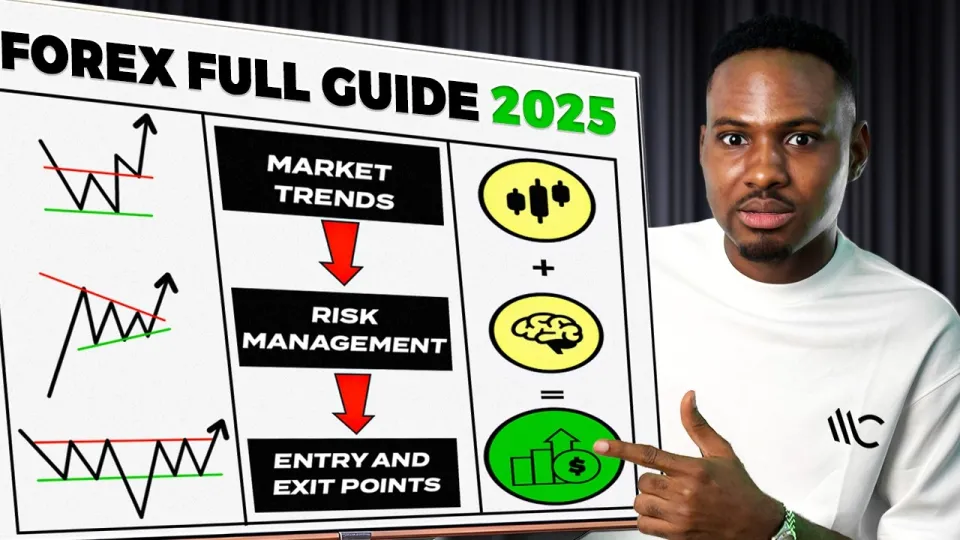
Video: How To Start Forex Trading For Beginners’ 2025 (Full Course)
You can order the same kind of articles for your own video to boost it on YouTube and Google. Just message the Telegram bot @sat_sit_bot. It writes articles around your video, embeds the video and publishes them on popular niche websites (no ads). Your first 50 articles are free.
· based on the channel Jeffrey Benson Forex
Key takeaways
- Forex is an over-the-counter market where currencies are quoted in pairs such as EUR/USD; trading happens 24 hours a day, five days a week.
- The four sessions — Sydney, Tokyo, London and New York — overlap twice a day, and the London–New York overlap is the most liquid window.
- A beginner needs three things: a regulated broker account, a charting platform such as MT5, and a written risk rule that caps loss per trade.
- One standard lot equals 100,000 units of the base currency; a 0.01 lot (micro lot) moves about $0.10 per pip on most USD-quoted pairs.
- Most beginners lose money in the first months because of oversized positions, no stop-loss and trading during news, not because of a bad strategy.
Forex trading for beginners starts with three concrete steps: open a demo account with a regulated broker, learn how currency pairs are quoted and priced in pips, and only then risk a small, fixed amount per trade with a stop-loss attached. Jeffrey Benson Forex walks through exactly this path in the full beginner course «How To Start Forex Trading For Beginners’ 2025», and students who want the structured version can enrol through the Fire Pips FX course plans.
What forex trading actually is and how currency pairs are quoted
Forex is the market where one currency is exchanged for another, and every price you see is a ratio between two currencies. A quote like EUR/USD 1.0850 means one euro buys 1.0850 US dollars; the first currency is the base, the second is the quote currency, and the pair rises when the base strengthens.
Three numbers do most of the work for a beginner:
- Pip — the standard unit of movement, usually the fourth decimal (0.0001). On EUR/USD one pip on a standard lot is about $10.
- Lot size — 1.00 lot is 100,000 units, 0.10 is a mini lot, 0.01 is a micro lot worth roughly $0.10 per pip.
- Spread — the gap between bid and ask, which is the broker's built-in cost on every trade; tighter spreads on EUR/USD and GBP/USD are why beginners start there.
Majors (EUR/USD, USD/JPY, GBP/USD, USD/CHF) trade the tightest; exotics such as USD/TRY or USD/ZAR carry wider spreads and sudden gaps that punish small accounts. Leverage is the multiplier that lets a $500 account control a much larger position — it magnifies both directions, which is why the same 20-pip move can be a 2% gain or a wiped account depending on lot size.
How the forex market works across the four sessions
Forex has no central exchange; banks, brokers and liquidity providers quote prices over the counter, so the market runs 24 hours a day from Monday to Friday. Volume rotates around four sessions: Sydney, Tokyo, London and New York, and liquidity peaks when London and New York overlap in the early US hours.
That schedule matters more than any indicator for a beginner. A strategy tested on EUR/USD during the London session can behave completely differently at 3 a.m. New York time, when spreads widen and moves become erratic. Pick one session, one or two pairs, and study them until the behaviour feels familiar. Because prices are quoted by many participants rather than a single exchange, weekend gaps are normal and stop-loss orders are not guaranteed — a fact that becomes important the first time a position is held over a Sunday open.
The tools a beginner needs before placing any trade
A workable beginner setup is small: a regulated broker, a charting platform, a position-size calculator and a trading journal. Jeffrey Benson Forex recommends MetaTrader 5 (MT5) in the course, and it is a reasonable default — it offers candlestick charts, dozens of indicators, one-click trading and a built-in economic calendar.
Before funding anything, check the broker: which regulator supervises it, whether client funds are segregated, what the minimum deposit is and how fast withdrawals are processed. A demo account is not optional — it is where you execute the first 50–100 trades without money at risk and prove the process works.
Then set up your workspace:
- Chart timeframe — start on the 1-hour and 4-hour charts; 1-minute charts produce noise and overtrading for newcomers.
- Two or three indicators maximum — a moving average for trend direction and an oscillator such as RSI is enough; stacking ten indicators creates contradictory signals.
- Position-size calculator — converts your risk in dollars into a lot size based on stop distance.
- Journal — records pair, session, entry reason, stop, target and outcome. Traders who write while learning retain far more than those who only watch, and the journal becomes the reference manual on demo.
Building a basic strategy foundation with risk management first
Risk management is the part of forex that decides whether a beginner survives long enough to become consistent. The standard rule is to risk no more than 1–2% of the account on a single trade, which means a $1,000 account should never have more than $10–$20 at stake on one position.
That single rule sets the lot size. If the stop-loss is 25 pips away and the risk budget is $10, the position is 0.04 lots on a USD-quoted pair — not 1.0 lot. Beginners who skip this step and size by gut feel are the ones who lose an account in a week.
A simple, testable strategy structure looks like this:
- Identify direction on the 4-hour chart using a moving average or higher highs and higher lows.
- Wait for price to pull back to a level — a previous support or resistance, or the moving average itself.
- Enter only when a candlestick confirmation appears, with the stop beyond the swing point and a target at least 1.5–2 times the stop distance.
- Log the trade and move on; no revenge trading after a loss.
A 1:2 risk-to-reward ratio means a trader can be right less than half the time and still be profitable. That arithmetic, not prediction accuracy, is what makes a strategy viable.
Placing your first trade step by step
A first trade should be small, planned and boring. Open MT5, confirm the broker connection is live, and check the spread before clicking anything — a 3-pip spread on a 20-pip target eats 15% of the profit.
- Select the pair, for example EUR/USD, and open a new order window.
- Set the volume in lots according to the calculator, not by feel.
- Enter the stop-loss and take-profit prices in the order ticket, not after the fill.
- Confirm the risk in currency equals your 1% budget, then execute.
- Screenshot the chart and write the trade in the journal the same day.
The first live trade is mostly a test of execution discipline: order type, spread, slippage and emotional response. Many beginners run this exact sequence 20 times on demo first, then repeat it live with a micro lot.
Common beginner mistakes and questions that keep coming up
Most beginner losses trace back to a short list of errors rather than a mysterious market. The most expensive are oversized positions, trading without a stop-loss, jumping between strategies every week, and trading high-impact news such as central bank rate decisions or US non-farm payrolls without understanding the volatility.
A second cluster is psychological. Beginners expect fast results, compare themselves to screenshots of profits, and over-leverage to catch up. The realistic picture: forex is a skill built over months of screen time, and consistency comes from a fixed process — same pairs, same session, same risk per trade — repeated until the numbers are stable.
A third is structural: unregulated brokers, signal groups used as a substitute for understanding, and accounts funded with money that is needed elsewhere. Copying trades can be a learning aid, but it teaches nothing about why a stop sits where it sits. Questions from viewers of the course repeat the same themes — how much capital is enough, how long before profits, whether a demo account really transfers to live trading — and the honest answers all point back to risk control and repetition.
Useful links
- Fire Pips FX course plans and student enrolment
- Free daily signal channel on Telegram
- Assex Markets broker registration
- Premium signal group access bot
The realistic path from first demo trade to consistent execution
Forex is learnable, but it is a skill measured in months, not weekends: understand the pair and the pip, pick one session, size every position from a fixed 1–2% risk budget, and journal every trade. The beginner course from Jeffrey Benson Forex is useful precisely because it sequences those steps — what forex is, how sessions work, which tools to install, how a strategy is built, how a first order is placed and which mistakes to avoid — instead of selling a shortcut. Treat the demo account as a mandatory stage, keep position sizes small when going live, and judge progress by rule-following rather than by a single winning week. If you want the structured route with mentorship, start from the Fire Pips FX plans page and compare it against free material before committing money.
Source: How To Start Forex Trading For Beginners’ 2025 (Full Course) · Markdown version
Questions & answers
How much money do I need to start forex trading?
You can open many accounts with $100–$500, but the amount matters less than the risk rule: with a $500 account and 1% risk, you have $5 at stake per trade, which keeps micro lots viable. Starting small on a demo account first costs nothing and shows whether your process survives real spreads.
How long does it take to become profitable in forex?
Most beginners need several months of consistent screen time and a few hundred journaled trades before results stabilise, and many never get there because they change strategies too often. Profitability usually shows up as a slow equity curve with controlled drawdowns, not as a fast doubling of the account.
Is copying signals a good way to start?
Copying trades can shorten the learning curve on execution — order types, spreads, position sizing — but it does not teach why a stop or target sits where it does. Use free signals as a supplement to your own demo practice, never as a replacement for understanding risk.
Do I need MetaTrader 5 or is another platform fine?
MT5 is a solid default because it is offered by most brokers, supports one-click trading, an economic calendar and automated strategies. Any platform that shows candlestick charts, lets you set stop-loss and take-profit in the order ticket, and connects to a regulated broker will do the same job.