How to find the perfect meme coin entry with chart setups and risk control that protect your capital
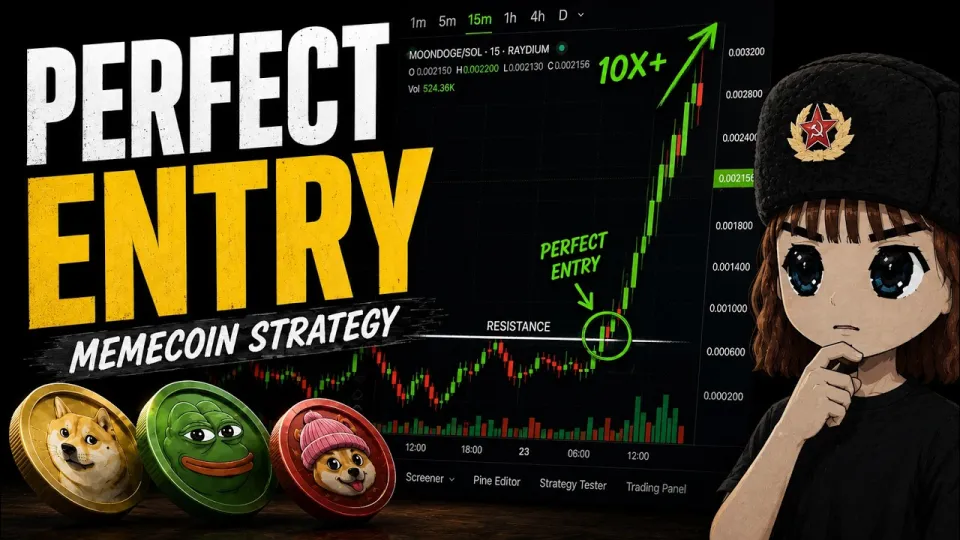
Video: How I Find the PERFECT Entry on Memecoins 📈 (Full Strategy)
You can order the same kind of articles for your own video to boost it on YouTube and Google. Just message the Telegram bot @sat_sit_bot. It writes articles around your video, embeds the video and publishes them on popular niche websites (no ads). Your first 50 articles are free.
· based on the channel starwifpump
Key takeaways
- Most meme coin losses come from bad timing, not bad coin selection — the entry defines the risk-to-reward of the whole trade.
- A valid entry needs three confirmations: momentum without vertical chasing, a pullback or support retest, and a predefined invalidation level.
- Chasing green candles and buying on FOMO is the single most common way traders turn a good narrative into a losing position.
- Red flags that block a trade: parabolic extension with no base, thin liquidity, and volume that dries up on the retest.
- Risk, exits and profit-taking are planned before the buy, not after the price starts moving against you.
A meme coin entry is the specific price level and confirmation set at which you buy, and it decides most of your risk-to-reward before the trade even starts. The workable approach is to wait for momentum, then buy the pullback or support retest with a predefined invalidation level, instead of chasing a green candle. Tools that bundle charting, sniping and position tracking in one terminal make that process repeatable — early access is available through the Plasma Telegram channel.
Why the entry matters more than the coin in meme coin trading
Most meme coin traders do not lose because they picked the wrong token; they lose because they entered at the wrong time. A token can double after your buy and still stop you out first if your entry sits at the top of a vertical move with no structure underneath. The same token bought on a controlled retest gives you a tighter stop, a bigger position size for the same risk, and room to hold through normal volatility.
That reframing changes the job: instead of hunting the next narrative, you build a repeatable process for deciding where a chart is worth buying. Selection is half the battle; location is the other half.
The three confirmations a meme coin chart must show before you buy
A high-quality meme coin setup is a chart that shows momentum, then a pause, then a reaction at a level you already marked. Three confirmations do most of the work:
- Momentum without verticality. The token has already printed an impulse with rising volume, but the candles are not 45-degree green walls. A move that has gone parabolic without a single higher-low is not an entry, it is a chase.
- A pullback or support retest. Price comes back to a level buyers previously defended — a prior consolidation range, a breakout level, or a moving average that has been respected. This is where risk is smallest and reward is largest.
- A defined invalidation. Before buying, you know the exact price where the idea is wrong. If that level is far below the current price, the setup is not good enough — the stop distance is the setup.
How to time a pullback entry without chasing the pump
A pullback entry means buying the first controlled retracement after an impulse, not the impulse itself. In practice the sequence looks like this: the token breaks out of a base on volume, extends, then retraces into the breakout zone or the prior range high. You want the retracement to be shallower and on lower volume than the impulse — that tells you sellers are not in control.
What you are avoiding is the classic FOMO trade: seeing a token up 40% on the timeline, buying the top of the candle, and then watching the retracement hit your stop before the move continues. Patience is not a personality trait here, it is a rule — if the chart does not give you a level, you do not have a trade. Waiting costs you nothing; a bad entry costs you the position.
Red flags that tell you not to enter a meme coin
A no-trade signal is as valuable as a setup, because it keeps you out of the trades that erase a week of gains. The chart tells you when to stand down:
- Parabolic extension with no base. Price has run for several candles without a higher-low; there is no logical place for a stop.
- Volume drying up on the retest. A pullback on collapsing volume can mean interest is gone, not that sellers are exhausted.
- Thin liquidity and wide spreads. Slippage turns a planned 10% stop into a much larger realized loss.
- Failed reclaim of a broken level. If price breaks support and cannot reclaim it, the structure has changed and the old setup is invalid.
- A narrative that already played out. If the reason you are buying is a headline everyone has already seen, you are exit liquidity, not an early buyer.
Planning risk, exits and profit-taking before the trade
Risk planning happens before the buy button, not after the price moves against you. A practical framework: define the invalidation level from the chart structure, size the position so that a stop-out costs a fixed small percentage of your account, and set the first profit target at the next obvious liquidity level rather than at a fantasy multiple.
Scaling out matters in meme coins because the distribution is violent — taking partial profit into strength protects the trade from a full round trip. Many traders also split capital so that a single failed entry cannot wipe the account; a common beginner mistake is sending the whole balance into one chart because the setup looked perfect.
Common questions from new meme coin traders
Beginners usually ask the same things: which filters to use in trackers, whether the same rules apply across chains, and how to catch tokens before the crowd. The honest answer is that filters and trackers only surface candidates — the entry decision still comes from the chart. Chain choice changes liquidity and speed, not the logic of momentum, pullback and invalidation. And no tracker replaces the discipline of skipping a bad setup; the traders who survive are the ones who take fewer, better-located trades.
Useful links
- Plasma Telegram for early access and setup help: https://t.me/+PF-2KHPgQqFiZWJh
- Discord community: https://discord.com/invite/fr6zzYyBxC
- Trading terminal via Padre: https://trade.padre.gg/rk/star
- Solpump: https://solpump.com/a/STARGOAT
- Author on X: https://x.com/starwifpump
Bottom line
A meme coin entry is a process, not a prediction: confirm momentum, wait for the pullback or support retest, define the invalidation, and size the position so a stop-out is survivable. The traders who last are not the ones who catch every pump — they are the ones who refuse the bad entries. The full strategy breakdown comes from the starwifpump channel, which walks through chart setups, red flags and risk planning step by step. If you want the tooling side handled in one place, start with the Plasma Telegram access link and paper trade the process before risking real capital.
Source: How I Find the PERFECT Entry on Memecoins 📈 (Full Strategy) · Markdown version
Questions & answers
What is the best entry point on a meme coin?
The best entry is a pullback or support retest after a confirmed impulse, with a tight and clearly defined invalidation level. Buying the vertical part of the move gives you a wide stop and poor risk-to-reward, even if the token keeps going up afterwards.
How do I avoid FOMO when a meme coin is pumping?
Set a rule that you only buy at levels you marked before the pump started. If price is already extended with no base and no higher-low, there is no trade — waiting costs nothing, while a chase entry can cost you the whole position.
Do the same entry rules work on every chain?
The logic of momentum, pullback and invalidation is chain-agnostic, but liquidity, spreads and transaction speed differ between networks. On thinner markets you need wider stops and smaller size because slippage can turn a planned loss into a much bigger one.
How should I plan risk and exits before buying a meme coin?
Define the stop from chart structure first, then size the position so a stop-out costs a fixed small percentage of your account. Set the first target at the next obvious liquidity level and scale out into strength instead of waiting for one perfect exit.